Case File
4
The Women Beneath St James
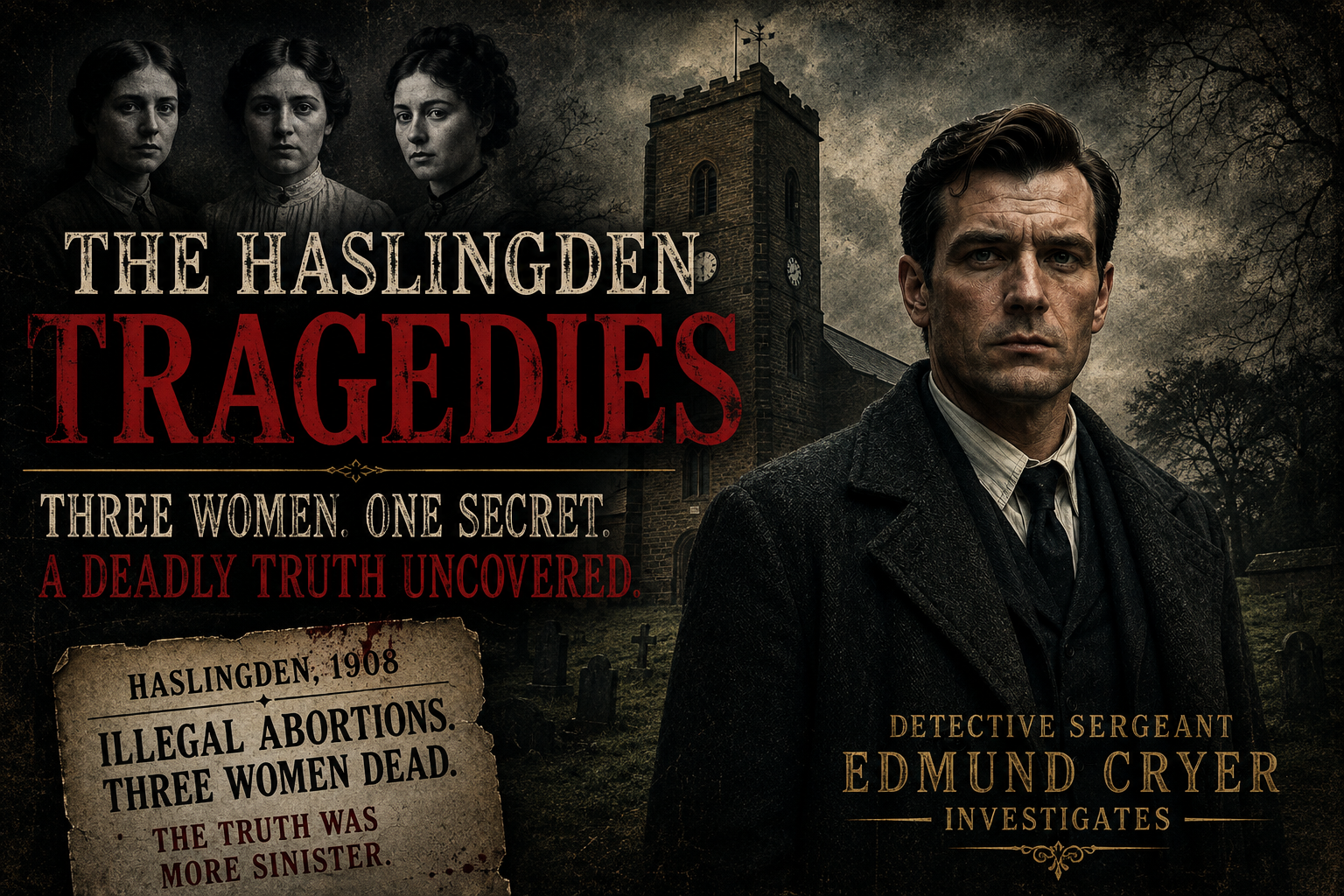
Three young women are dead, their deaths seemingly linked to the same woman and the same terrible secret. But when Detective Sergeant Edmund Cryer begins to look beyond the obvious explanation, he uncovers a truth buried beneath the grounds of St James’ churchyard - and a murderer whose name may never be known.
Haslingden lay beneath a low, oppressive Lancashire sky, the kind that seemed to press down upon the rooftops and mill chimneys until the whole town felt caught beneath its weight. Smoke drifted across the valley in slow, heavy ribbons, blurring the outlines of the factories and settling into the narrow streets where men trudged to work long before dawn. Children hurried along cobbled roads with satchels clutched to their chests, and families lived shoulder‑to‑shoulder in terraces and cramped tenements where every sound travelled through thin walls. To anyone passing through, Haslingden looked no different from a dozen other industrial towns scattered across the north - a place shaped by labour, routine and the quiet endurance of ordinary people.
Yet beneath that familiar surface lay secrets that the town carried like old scars. Some belonged to individuals who had learned to keep their troubles hidden behind closed doors. Others belonged to the town itself, woven into its history and whispered only when the right company was present. And in the early months of 1908, three young women found themselves caught within one of those secrets - a story that began quietly, almost invisibly, before widening into something far darker.
Each of the women faced a desperate situation. Each was pregnant. And each, believing she had nowhere else to turn, eventually sought the help of the same woman: Martha Vale, a widow who lived in a crowded tenement and performed illegal abortions for those who arrived at her door in fear and silence. Within weeks, all three women were dead. At first, the explanation seemed tragically simple. The procedures had gone wrong, complications had followed, and the women had succumbed to the consequences. But beneath that tidy conclusion lay a truth that had been overlooked, and by the time Detective Sergeant Edmund Cryer uncovered it, two of the women were already buried beneath the damp earth of St James’ churchyard.
CHAPTER ONE - ELEANOR BRIGGS
Eleanor Briggs was twenty‑eight years old, married, and outwardly settled when she discovered she was pregnant. Whatever led her to seek an abortion was something she never shared, carrying the reason with her into death. In 1908, a woman in her position had few safe choices. Abortion was illegal, and those who found themselves desperate relied on whispered recommendations, quiet nods from neighbours, and the hidden knowledge of others who had walked the same path.
Eventually, Eleanor was given Martha Vale’s name.
Martha lived in a tenement where families crowded together in rooms barely large enough for their furniture. The building was a maze of narrow staircases, echoing corridors and doors that opened and closed at all hours. Martha’s work was not openly spoken of, yet it was not entirely concealed either. Women who needed her found their way to her rooms with a mixture of dread and relief.
Eleanor underwent the procedure and returned home. For a short time, nothing seemed amiss. She rested, grew pale, and tried to resume her routine. But soon her condition worsened. Illness took hold quickly, and within days she was dead. The doctor who examined her found clear evidence of an illegal abortion and concluded that complications had killed her. No further questions were asked. Eleanor Briggs was buried quietly in St James’ churchyard, her death recorded as another tragedy born of desperation.
Not long afterwards, another woman followed the same path.
CHAPTER TWO - LUCY HARWOOD
Lucy Harwood was twenty‑three, unmarried, and terrified when she learned she was pregnant. Like Eleanor, she found herself trapped by circumstance, unable to imagine a future in which she could carry the child. Eventually, she too was directed toward Martha Vale.
The pattern repeated with unsettling precision. Lucy underwent the procedure, returned home, and soon became gravely ill. Her decline was swift, her suffering severe, and she died before anyone could save her. Now two women were dead, both connected to Martha Vale, both victims of illegal operations that seemed to have ended in fatal complications.
This time, the authorities acted. Martha’s rooms were searched, and investigators found instruments, linens and bottles that confirmed her work. She was arrested, and the case appeared to settle neatly into place. Two women had visited Martha Vale. Two women had died. The doctor’s conclusions seemed unshakeable.
But while the police focused on Martha, they did not yet know that a third woman had already undergone the same procedure - and her fate would unravel everything.
CHAPTER THREE - SARAH BELL
Sarah Bell was nineteen, frightened, and already recovering at home when Martha Vale was taken into custody. She had visited the tenement before Martha’s arrest, undergone the same procedure, and returned home to rest. At first, her illness seemed to confirm the police theory. She grew weak, vomited repeatedly, and deteriorated with alarming speed.
By the time help arrived, Sarah was close to death. She died within hours.
The doctor who examined her found evidence of the abortion and prepared to reach the same conclusion as before. But Detective Sergeant Edmund Cryer felt something shift. He had been assigned to the investigation after the first two deaths, and until Sarah’s case, nothing had challenged the assumption that Martha’s procedures had caused the tragedies. Yet Sarah’s death occurred while Martha was already locked in a cell.
The abortion might explain Sarah’s vulnerability. It did not explain the violence of her illness.
Cryer ordered a more thorough examination and two days later, the answer arrived.
Sarah Bell had been poisoned.
CHAPTER FOUR - THE QUESTION NOBODY HAD ASKED
The discovery forced Cryer to revisit the earlier deaths. Eleanor Briggs and Lucy Harwood had also suffered severe sickness. Both had deteriorated rapidly after leaving Martha’s rooms. Yet neither had been examined for poison. The doctors had believed they already knew the cause, and once that assumption settled into place, no one had looked beyond it.
Sarah Bell’s death shattered that certainty.
If poison had killed Sarah, what had killed Eleanor and Lucy?
Cryer requested permission to exhume their bodies. It was a difficult decision, one that reopened wounds for families who had already buried their grief. But permission was granted, and on a cold March morning, Eleanor Briggs’ grave was opened. Rain clung to the grass as cemetery workers lifted her coffin from the earth. Cryer and Detective Constable Arthur Mallory stood nearby, watching in silence as a woman whose death had seemed explained was brought back into the light.
Mallory eventually turned to Cryer and asked whether he truly believed the doctor had been wrong. Cryer stared at the open grave and replied that the doctor had been certain - and that certainty was not the same as truth.
Eleanor’s body was examined. Lucy Harwood’s followed. This time, the doctors knew what to look for.
Both women had been poisoned.
CHAPTER FIVE - THE WOMAN IN THE CELL
Three women had visited Martha Vale and all three had undergone illegal abortions. All three had become violently ill. And all three had been poisoned. The procedures had not killed them. They had merely provided a convenient explanation - one that allowed the real cause of death to hide in plain sight.
Cryer visited Martha in her cell and told her what had been discovered. She listened in silence, absorbing the truth that both condemned and exonerated her. She had broken the law, placed vulnerable women in danger, and carried out procedures that could easily have ended in tragedy. But Cryer was now convinced she was only guilty of carrying out illegal abortions - not poisoning!
CHAPTER SIX - THE TENEMENT
Cryer returned to the tenement where Martha had lived and worked. The building was as crowded and chaotic as ever, filled with the noise of families living in close quarters. Doors opened and closed constantly. Children darted through narrow passages. Neighbours visited one another without ceremony. Strangers could enter and leave without attracting attention.
Martha’s rooms had never been isolated. Anyone who knew what happened there could have gained access to the women who visited her. A neighbour might have brought food or drink. Someone could have offered medicine to a recovering woman. A visitor could have climbed the stairs, lingered briefly, and vanished again without anyone remembering their face.
The more Cryer considered it, the more he realised how easily the murderer could have hidden. The poison might not have been administered inside Martha’s rooms at all. It could have been given afterwards - by someone the women trusted, someone who followed them home, or someone who lived within the very building Cryer was now searching.
The possibilities stretched endlessly and yet the evidence did not.
CHAPTER SEVEN - THE TRAIL GOES COLD
Over the following months, Cryer and Mallory traced the final movements of all three women. They spoke to families, neighbours, and anyone who had seen the women in the hours before their illnesses began. But the investigation produced confusion rather than clarity. People remembered figures on staircases, strangers passing through corridors, and fleeting glimpses of unfamiliar faces. Yet few could provide names or reliable descriptions. Some witnesses changed their stories. Others grew uncertain of what they had originally claimed.
Arguments broke out within the tenement. Old grudges surfaced. Several people had reasons to dislike Martha Vale, and others had connections to the women who had died. But suspicion was not proof.
Cryer could not determine who had obtained the poison, how it had been administered, or whether the same person had killed all three women.
The murderer had been given an extraordinary advantage. For weeks, the authorities had been looking in the wrong direction. Martha Vale had seemed the obvious suspect, and the evidence of her illegal work had supported that assumption. By the time Sarah Bell’s death revealed the truth, precious time had already slipped away.
The killer had vanished into ordinary life.
CHAPTER EIGHT - THE CASE WITHOUT A NAME
Martha Vale still faced consequences for the illegal procedures she had performed, but the accusation of murder could no longer stand. Cryer had uncovered the truth. Eleanor Briggs, Lucy Harwood and Sarah Bell had been poisoned, yet knowing what had happened was not the same as knowing who had done it.
Before the investigation faded from public attention, Cryer visited Martha one final time. She asked whether he knew who had killed the women. Cryer answered simply: "no".
Martha turned toward the small window of her cell and said the murderer was still out there - and that Cryer may never find out who it was.
Perhaps she was right. The killer could have been someone Cryer had already questioned. Someone who had watched the police search the tenement. Someone who had offered sympathy to grieving families or stood silently nearby as the graves in St James’ churchyard were opened. Perhaps the murderer had never left Haslingden at all.
Cryer returned to the tenement one last time. The building looked unchanged. Children moved through the passages. Doors opened and closed. Families carried on with their lives. Nothing revealed that three women had been murdered. Mallory stood beside him and asked whether Cryer believed one of the tenants had done it. Cryer looked at the doors and windows and admitted he did not know.
It was the only honest answer he could give.
They had uncovered the truth about the deaths. But they had never uncovered the name behind them.
CHAPTER NINE - THE WOMEN BENEATH ST JAMES’
The deaths of Eleanor Briggs, Lucy Harwood and Sarah Bell were never solved. At first, their stories had seemed tragically straightforward - three women seeking help, three women becoming ill, three women dying. Martha Vale appeared to be the explanation, especially after three deaths were linked to her.
For Edmund Cryer, the case could never truly be closed. He knew what had happened. He understood how the murders had been hidden. But he never discovered who was responsible. Somewhere in Haslingden, the person who carried the poison may have continued with their life as though nothing had happened. They may have watched the investigation unfold, knowing Martha Vale had been blamed for crimes she had not committed. They may even have stood beside the graves in St James’ churchyard as the truth was finally uncovered.
And when the investigation faded into silence, the murderer remained what they had always been - just another face in the crowd.
COPYRIGHT & FICTION DISCLAIMER
© Gaslight Murders. All rights reserved.
This case file is a work of historical fiction created for entertainment and storytelling purposes. While certain locations, historical periods, events and social conditions may be inspired by real history, the characters, investigations, dialogue, crimes and circumstances depicted within this story are fictional unless otherwise clearly stated.
Edmund Cryer and the wider Gaslight Murders universe are original fictional creations. Any resemblance to real persons, living or dead, or to actual events, is purely coincidental unless specifically acknowledged.
This story may contain themes and subject matter reflective of the historical period in which it is set, including crime, death and other disturbing events.
No part of this case file may be reproduced, copied, distributed or republished without prior written permission from Gaslight Murders, except where permitted by applicable copyright law.
← View All Case Files