
Case File
5
The Day I Saw Evil
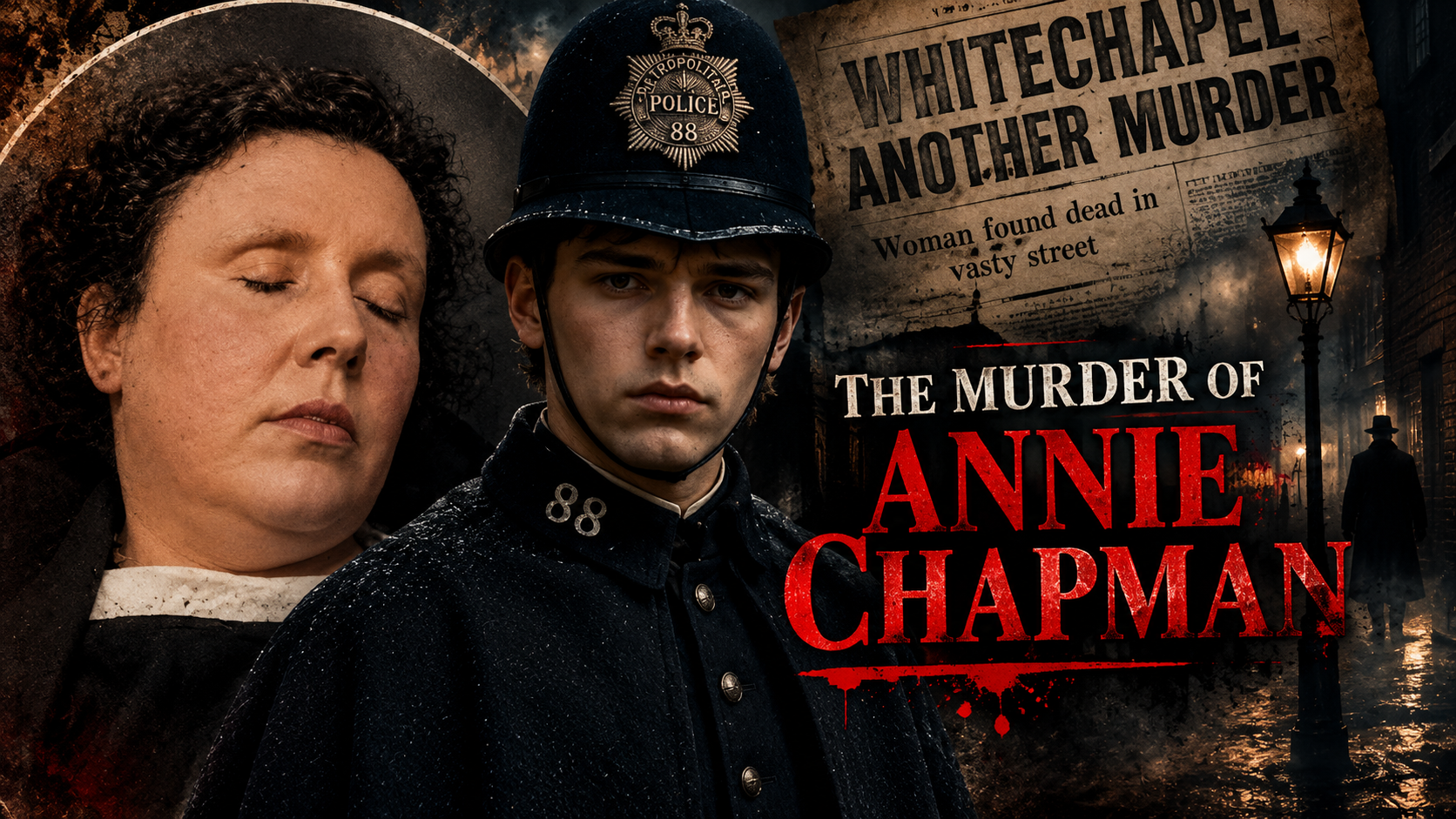
The story that changed Edmund Cryer forever. As a young Police Constable in Whitechapel, Edmund is called to 29 Hanbury Street on the morning Annie Chapman is murdered. Confronted by death and the terrifying reality of what one human being can do to another, he finds himself changed forever. This is the moment the investigator inside Edmund Cryer first opened his eyes.
In the hours before dawn, when the lamps flickered weakly and the fog hung low enough to taste, Whitechapel felt like a trap. The alleys seemed to close in around me, the brickwork leaning forward as though listening to my footsteps. The air was thick, sour, and slow to move. Every sound - a cart wheel, a door slam, a cough in the dark - seemed to echo too long, as if the night refused to let it go.
The smells were worse. Coal smoke clung to the throat. Horse manure mixed with stale beer and sweat. Rot seeped from the gutters, rising in waves that made my stomach tighten. Beneath it all lay the deeper stench of poverty - the smell of too many bodies pressed together, breathing the same exhausted air. It was the scent of a city that had forgotten how to care for its own.
This was the Whitechapel I walked each night as a young Police Constable. A place where the darkness felt territorial, where the narrow streets seemed to close behind you, and where even the faintest breeze carried whispers of things better left unheard. I never admitted it at the time, but the night unsettled me. It seemed to watch me. The shadows seemed to follow. And the silence between sounds felt like a warning.
By the morning of September 8th, 1888, Whitechapel had tightened even further.
Word had travelled fast, too fast - that a woman had been found murdered in the backyard of 29 Hanbury Street.
Annie Chapman. A name that would soon echo through every tavern and newspaper in London.
I arrived before the sun had properly risen, the fog still heavy enough to blur the outlines of the houses. The crowd had already gathered - neighbours, labourers, women clutching shawls — drawn by fear, curiosity, and something darker: the human need to stare at horror.
I did not know her name then. I did not know her story. I only knew that something waited for me in that yard.
Annie Chapman had been forty‑seven years old. Small, thin, barely five feet tall. Her complexion sallow, her hair brown and beginning to turn grey. She had blue eyes, though those who knew her said they had dulled in recent years. Poverty had carved its marks deep into her face. Illness had hollowed her cheeks. She had once lived a stable life,v a husband, children, a home - but tragedy and drink had dragged her down into the alleys of Whitechapel, where survival was measured in pennies and nights without hunger.
That morning, she had been dressed in a dark skirt and black jacket, layered against the chill. A brown bonnet. A striped scarf. A red‑and‑white checked handkerchief tucked into her pocket. Ordinary things, worn by an ordinary woman who had become invisible in a city that no longer saw her.
Her body was found shortly before six o’clock, lying on her back near the steps of the back door. Her head close to the house, her feet pointing toward the fence. Her clothing had been pulled up around her waist. Her throat was cut deep - a wound so violent it seemed almost surgical - and her body had been mutilated with a precision that defied comprehension. The yard was small, enclosed, hemmed in by walls that trapped the fog and the smell of blood. Whoever had done this had done it quickly, quietly, in the dark.
I stood at the edge of that yard, my breath catching in my throat. It was the first dead body I had ever seen.
The shock hit me like a blow. My lungs tightened. My vision narrowed. The world seemed to tilt, as though the air itself had thickened. I saw the sheet that covered her, the blood soaking through, the lantern light trembling on the cobbles. I felt the walls closing in, the silence pressing against my ears until I could hear nothing but my own heartbeat. I saw what a human being had done to another, and something inside me recoiled.
Only later would her name be spoken aloud - Annie Chapman - and with it, the story of a life that had fallen apart piece by piece until it ended here, in this yard, beneath the fog.
I realised, with a clarity that chilled me, that evil did not announce itself. It did not roar. It did not stride through the streets like a monster from a child’s tale. It moved quietly. It blended in. It could pass me on the pavement, nod politely, and vanish into the night without leaving a trace.
Evil was not a creature. It was a man. A man like any other.
The murders would continue. Fear would spread like mould through the walls of Whitechapel. Women would hurry home before the sun dipped below the rooftops.
Footsteps behind you would sound louder, sharper, more threatening. Every shadow would seem deeper. Every stranger would seem capable of terrible things.
And I carried that morning with me for the rest of my life.
I remember the smell - the sour mix of rot and coal smoke. I remember the noise of the crowd pressing against the cordon. I remember the damp cobbles beneath my boots, the pale faces staring past me, and the awful stillness of the yard where Annie Chapman lay. I remember the shock of seeing death for the first time - not peaceful, not gentle, but violent and obscene. I remember the suffocating air, the claustrophobic silence, the sense that the world had shrunk to the size of that yard.
Years later, when I became an investigator, when I stepped into rooms where death lingered in the air, when I learned to search for the smallest detail, the overlooked footprint, the object out of place, the inconsistency in a witness’s story - I realised I was still that young constable in Whitechapel.
Still standing behind the cordon. Still staring at Annie Chapman. Still asking myself the question that lodged itself deep within me:
How could one human being do this to another?
I have never forgotten the answer. And I have never forgotten the woman who taught me to ask.
Annie Chapman. Whitechapel. September, 1888.
The morning I first understood what humanity was capable of - and the morning the investigator inside me opened his eyes.
I did not sleep that night. I doubt anyone in Whitechapel did. The fog clung to the windows of the station, pressing against the glass like a living thing, and every time I closed my eyes I saw the yard again — the narrow walls, the trembling lantern light, the sheet that did nothing to hide the violence beneath it.
I sat at my desk long after my shift had ended, staring at my hands. They would not stop shaking. I tried to steady them, but the tremor returned each time I thought of her face - not the face I saw, but the face I imagined she must have had before life had worn her down. Before poverty had hollowed her cheeks. Before illness had taken its toll. Before the world had forgotten her.
I remember the sergeant walking past me, muttering under his breath. “Another one,” he said. Another one. As though these women were entries in a ledger.
I wanted to shout at him. I wanted to tell him she had been a person, not a number. But my voice felt trapped somewhere deep in my chest, and all I could do was sit there, listening to the scratch of pens and the low murmur of voices as the station tried to make sense of what had happened.
It was sometime after midnight when I first heard the name. A constable came in from the yard, stamping the damp from his boots. He leaned over the desk of another officer and whispered something. The officer frowned, then whispered back. The constable shook his head.
“Ripper,” he said quietly. “Some of the men are calling him the Ripper.”
I felt the hairs rise on the back of my neck. I had heard rumours, of course. The murder of Mary Ann Nichols only days earlier had unsettled the district. But rumours are one thing. A name is another. A name gives shape to fear. A name makes it real.
I did not speak. I simply sat there, listening as the word drifted through the station like smoke. Ripper. Ripper. Ripper.
It felt obscene. It felt wrong. It felt like giving the killer exactly what he wanted.
I left the station just before dawn. The fog had not lifted. It hung low over Whitechapel, swallowing the rooftops and blurring the lamps until they looked like dying stars. The streets were quiet, but not peaceful. There was a tension in the air, a sense that something had shifted, something had broken, and nothing would be the same again.
I walked without thinking, my boots slipping slightly on the damp cobbles. Every shadow seemed deeper. Every alley seemed narrower. Every sound - a distant footstep, a cough behind a door - made my heart jump. I kept turning, expecting to see someone behind me. But each time I looked, the street was empty.
I realised then that fear had a weight. And it had settled on my shoulders.
I reached my lodgings and sat on the edge of the bed, still in my uniform. I could not bring myself to remove it. It felt like armour, thin though it was. I stared at the wall until the light began to change, until the fog outside shifted from black to grey.
I thought of Annie Chapman. I thought of her small frame, her thin hands, her worn clothing. I thought of the life she had once had, a husband, children, a home - and how it had slipped away from her piece by piece until she found herself alone in Whitechapel, fighting for survival.
I thought of the way she had been left. Alone in that yard. In the dark. In the cold. In the fog.
I felt something inside me harden and I knew then that I could not remain the man I had been. I could not be simply a constable who pushed back crowds and took statements. I needed to understand. I needed to see what others missed. I needed to find the man who had done this - not because I believed I could stop him, but because I could not bear the thought of another woman lying alone in the dark.
That morning, as the sun struggled to break through the fog, I made a quiet promise to myself.
I would learn to read the streets. I would learn to read the people. I would learn to read the darkness.
I would become the kind of man who could walk into a room and see what others overlooked - the footprint half‑hidden in mud, the object slightly out of place, the lie buried in a witness’s voice.
I did not know it then, but that morning was the beginning. The beginning of the investigator I would one day become. The beginning of a life spent chasing shadows.
The beginning of a long, bitter education in the nature of evil.
And it all began with her.
Annie Chapman. Whitechapel. September, 1888.
The night I saw evil. And the morning I understood that I would spend the rest of my life trying to find it.
Watch the Investigation
Annie Chapman
This investigation is available to website members.
Membership is completely free. Create an account to unlock exclusive case investigations and watch the full video.
Join Free / Sign InCOPYRIGHT & FICTION DISCLAIMER
© Gaslight Murders. All rights reserved.
This case file is a work of historical fiction created for entertainment and storytelling purposes. While certain locations, historical periods, events and social conditions may be inspired by real history, the characters, investigations, dialogue, crimes and circumstances depicted within this story are fictional unless otherwise clearly stated.
Edmund Cryer and the wider Gaslight Murders universe are original fictional creations. Any resemblance to real persons, living or dead, or to actual events, is purely coincidental unless specifically acknowledged.
This story may contain themes and subject matter reflective of the historical period in which it is set, including crime, death and other disturbing events.
No part of this case file may be reproduced, copied, distributed or republished without prior written permission from Gaslight Murders, except where permitted by applicable copyright law.
← View All Case Files